Start with the essentials
Understand AI without the fog.
A clear, human-first map of artificial intelligence, machine learning, large language models, and generative AI.
Jump into the guide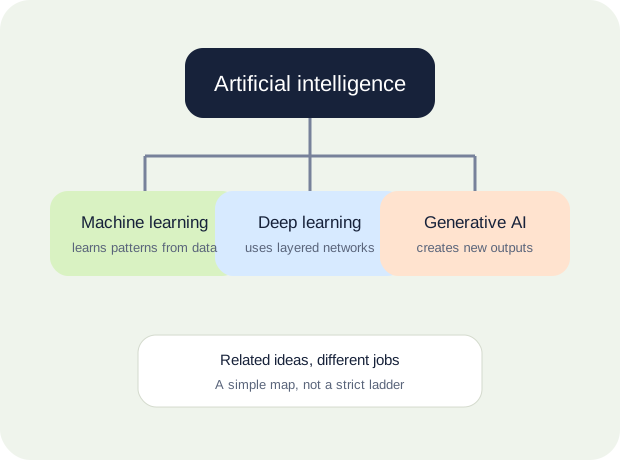
The words are related, but they are not interchangeable
Artificial intelligence is the broad field of building systems that perform tasks associated with human reasoning or perception. Machine learning is one approach within that field: a system learns patterns from examples rather than following only hand-written rules. Deep learning uses layered neural networks to learn more complex patterns.
Generative AI refers to systems that produce new material, such as text, images, audio, or code. A large language model is one kind of generative model that works with language. These categories overlap, but each describes a different idea.
What happens when you ask a language model a question?
A language model receives text as tokens, uses patterns learned during training to estimate what token could come next, and generates a sequence one step at a time. It can sound confident because it is good at producing fluent text. Fluency alone does not prove that a statement is true.
Think of a model as a capable drafting and pattern-finding system. It can help you explore a subject, but important claims still need evidence from reliable sources.
A useful mental model
You provide instructions and context. The model generates a response. You decide whether it meets the goal, what needs checking, and what to do next.
The person using the system remains responsible for deciding whether the output is appropriate for the task.